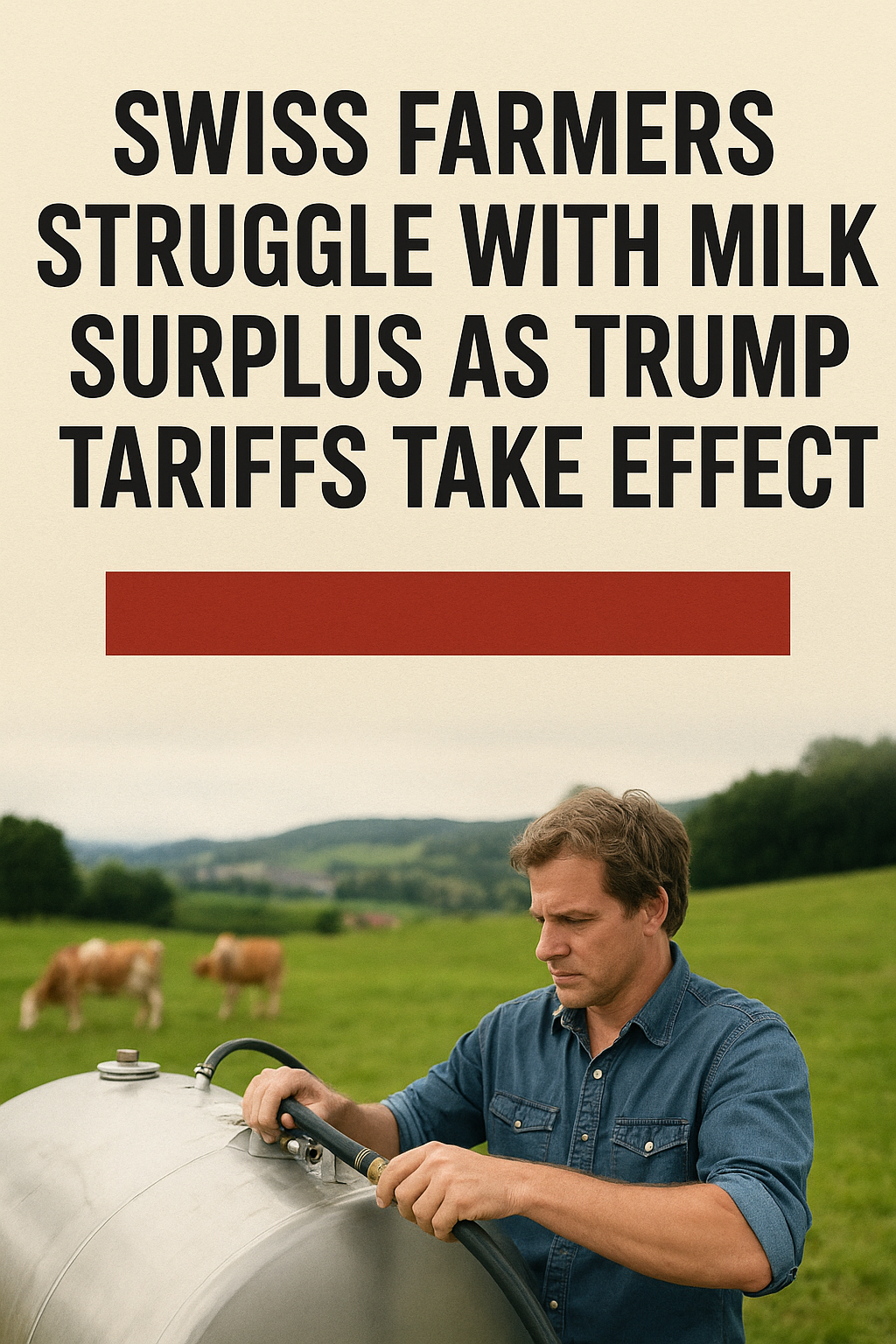
Swiss farmers, known for producing some of the world’s finest dairy, are facing an unexpected crisis: too much milk and nowhere to send it.
This surplus didn’t appear out of thin air — it’s the direct result of new tariffs imposed by the Trump administration, which have disrupted global agricultural trade in ways Switzerland did not anticipate.
🥛 A Sudden Shock to a Stable Industry
For decades, Switzerland’s dairy market has been steady, predictable, and deeply rooted in tradition. Swiss milk producers export a portion of their products — particularly specialty dairy — to global markets, including the United States.
However, the new U.S. tariffs on foreign dairy imports have abruptly closed one of the more profitable export pipelines.
Because of this, Swiss producers are now struggling with storage, falling milk prices, and pressure from cooperatives to reduce production.
🌍 Why Trump’s Tariffs Hit Switzerland Hard
Although Switzerland is not a major exporter to the U.S. compared to countries like Germany or France, the dairy ecosystem is interconnected. When the U.S. introduces tariffs:
-
European producers redirect their milk to intra-EU markets
-
The EU becomes flooded with excess supply
-
Swiss milk, competing with cheaper EU products, is pushed out
-
Domestic storage tanks fill up faster than expected
All of this results in an unavoidable surplus for Switzerland — and a financial headache for its farmers.
🐄 Farmers on the Ground: “We Can’t Store It, and We Can’t Sell It”
Swiss dairy farms operate on precise schedules. Cows produce milk daily, and with limited storage facilities, farmers cannot simply “pause” production.
Many are now:
-
Selling milk at reduced prices
-
Turning raw milk into lower-value products like powder
-
Lobbying the government for emergency subsidies
A farmer from Lucerne summed up the mood:
“Our cows keep producing, but the market doesn’t want our milk anymore.”
💥 Ripple Effects Across Europe
Switzerland isn’t alone. Neighboring dairy economies — Austria, France, and Germany — are dealing with similar turbulence.
But Switzerland, not being part of the EU, faces more limited safety nets and trade flexibility.
The dairy surplus has already led to:
-
Increased waste
-
Falling wholesale prices
-
Rising political pressure on Bern to intervene
🧀 Government Response: Stabilize Now, Reform Later
Swiss authorities are debating several solutions:
-
Temporary subsidies to secure farmers’ income
-
Expanded domestic dairy initiatives (like promoting local cheese exports)
-
Negotiations with EU partners to rebalance supply chains
-
Emergency storage funding to keep milk from being wasted
But none of these are fast fixes.
The surplus continues to grow daily.
🌐 Global Politics, Local Consequences
This crisis highlights how a single trade decision by a global superpower can destabilize small but highly specialized industries elsewhere.
For Swiss farmers, Trump’s tariffs weren’t just an economic strategy —
they became a direct hit to their livelihoods.
And until the trade environment stabilizes, Switzerland’s dairies may continue to overflow.
🇩🇪 SCHWEIZERDEUTSCH VERSION
Schwiizer Bure kämpfed mit Milch-Überschuss wäge de neie Zölle vo de Trump-Regierig
D’Schwiizer Milchbure stöh vor eme unerwartete Problem: z’viel Milch und nümme gnue Märkt, wo’s öppis abnehmed.
De Grund für dä Überfluss liit i de neie US-Zölle, wo d’Trump-Regierig iiführt het und wo jetzt d’welti Märkt durenee bringt.
🥛 E Schock für e stabili Industrie
D’Milchproduktion i de Schwiiz isch seit Joorzehnte stabil und zuverlässig. En Teil vo de Produkter geit i d’Export – au i d’USA, wo Schwiizer Spezialprodukte beliebt sind.
Mit de neue Zölle aber sind wichtigi Absatzmärkt praktisch zueganga, und jetzt kämpfed d’Bure mit:
-
völle Lager
-
sinkende Milchpriese
-
Druck vo de Molkereie, wäge z’viel Produktion
🌍 Wieso treffe d’US-Zölle d’Schwiiz so fest?
Auch wenn d’Schwiiz nöd z’de grösste Exporteur i d’USA isch, isch de europäisch Milchmarkt komplett vernetzt:
-
EU-Länder lönd ihre Milch nümme in d’USA
-
Drum schüpped sie s’viel meh in de EU-Binnenmarkt
-
D’EU wird überschwemmt
-
Schwiizer Milch wird verdrängt und het kei Platz meh
-
Und d’Schwiiz-Lager füllend sich im Rekordtempo
🐄 „Mir chönd d’Milch nöd stoppe – aber niemer will si“
Schwiizer Küeh gäh tägig Milch – d’Produktion cha nid einfacch pausiert werde.
Drum mached d’Bure jetzt:
-
Verkaufe z’Tiefpriese
-
Verarbeite Milch z’Pulver
-
Bitte um staatlich Hilf
E Bure us Lozärn seit:
„D’Küe mache witer – aber dr Markt wott’s nümme.“
💥 Folge für ganz Europa
Au öpper wie Öschtriich und Dütschland kämpfet mit de Folgä vo de US-Politik.
Aber d’Schwiiz het weniger flexible Lösige, will si nöd i de EU isch.
🧀 D’Bundesregierig: Stabilisiere – und spöter reformiere
I Bern diskutiere sie über:
-
temporäri Subventione
-
meh Förderung für Schwiizer Milchprodukte
-
Verhandlige mit de EU
-
Geld für Lagerkapazität
Aber e schnelli Lösig git’s nöd.
🌐 Globali Politik – lokal entscheidi Folgen
Was a Washington entschide wird, cha ä Schockwälle bis i d’Schwiizer Bergdörfer uselöse.
Trump si Zölle sind für Bure nid nur Politik – sondern es reali Risiko für ihr Einkommen.
🇫🇷 SWISS FRENCH VERSION
Les agriculteurs suisses font face à un surplus de lait à cause des nouveaux tarifs imposés par l’administration Trump
Les producteurs laitiers suisses se retrouvent avec trop de lait et pas assez de débouchés.
La raison : de nouveaux tarifs américains qui perturbent fortement les marchés mondiaux.
🥛 Un choc pour une industrie habituellement stable
La Suisse exporte une partie de son lait et de ses dérivés, y compris vers les États-Unis.
Mais avec les nouveaux tarifs, ces marchés deviennent soudainement inaccessibles.
Résultat :
-
stocks pleins
-
prix du lait en baisse
-
pression pour réduire la production
🌍 Pourquoi les tarifs de Trump touchent-ils autant la Suisse ?
Le marché européen est interconnecté :
-
l’UE ne peut plus envoyer son lait aux États-Unis
-
elle inonde donc le marché interne
-
la concurrence augmente
-
les produits suisses sont repoussés
-
les réserves suisses explosent
🐄 « Nos vaches produisent, mais personne ne veut du lait »
Impossible de stopper les vaches du jour au lendemain.
Les agriculteurs doivent donc :
-
vendre à perte
-
transformer le lait en poudre
-
demander des aides fédérales
💥 Des répercussions dans toute l’Europe
Même les pays voisins subissent la pression, mais la Suisse, hors UE, a moins d’options de secours.
🧀 La réponse du gouvernement
La Confédération discute de :
-
subventions temporaires
-
soutien renforcé aux exportations
-
négociations avec l’UE
-
financement du stockage
Mais rien ne résout le surplus immédiatement.
🌐 Quand la politique américaine bouleverse les Alpes
Les décisions de Washington peuvent transformer la vie des éleveurs suisses.
Les tarifs de Trump en sont la preuve.
🇮🇹 SWISS ITALIAN VERSION
Gli agricoltori svizzeri affrontano un surplus di latte a causa delle nuove tariffe imposte dall’amministrazione Trump
La Svizzera si trova con troppo latte e poche possibilità di esportarlo.
Il motivo? Nuove tariffe statunitensi che stanno sconvolgendo i mercati globali.
🥛 Uno shock per un settore tradizionalmente stabile
Una parte dei prodotti lattieri svizzeri viene esportata, anche verso gli USA.
Ma ora quei canali sono praticamente bloccati.
Conseguenze:
-
magazzini pieni
-
prezzi in calo
-
pressioni per ridurre la produzione
🌍 Perché le tariffe USA colpiscono la Svizzera?
Il mercato europeo reagisce a catena:
-
l’UE non può più esportare negli USA
-
riversa il latte sul mercato interno
-
l’offerta cresce
-
i prodotti svizzeri perdono spazio
-
le scorte svizzere esplodono
🐄 “Le nostre mucche continuano a produrre, ma nessuno vuole il latte”
Gli allevatori non possono fermare la produzione.
Così cercano di:
-
vendere a prezzi più bassi
-
trasformare il latte in polvere
-
ottenere aiuti d’emergenza
💥 Effetto domino in Europa
Anche altri Paesi stanno soffrendo, ma la Svizzera ha meno margine d’azione essendo fuori dall’UE.
🧀 La risposta del governo svizzero
In discussione:
-
sussidi temporanei
-
promozione del formaggio svizzero
-
dialogo con l’UE
-
fondi per lo stoccaggio
🌐 Politica globale, conseguenze locali
Una decisione presa a Washington può cambiare la realtà di un allevatore svizzero nelle Alpi.
Le tariffe di Trump ne sono la prova.